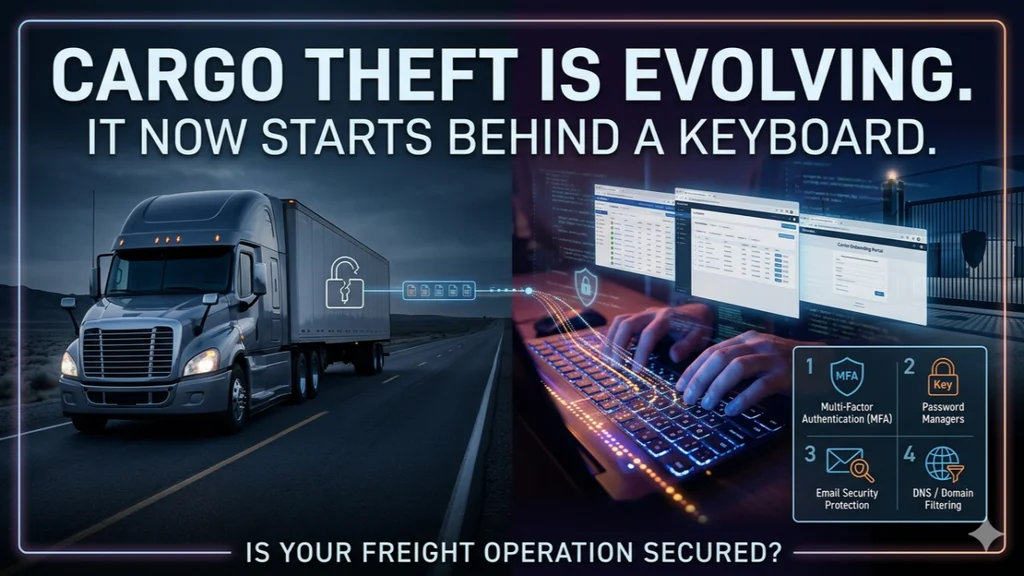
Cargo theft is evolving.
For decades, theft in the freight industry meant cutting a trailer seal, hijacking a truck at a rest stop, or breaking into a warehouse. Today, much of cargo theft begins long before a truck ever leaves the dock.
It starts behind a keyboard.
Across the transportation industry, we are seeing a surge in strategic cargo theft, where criminals impersonate carriers, manipulate load boards, intercept communications, and redirect freight to locations where it disappears into secondary markets.
The truth is uncomfortable.
Many of these incidents are not caused by highly sophisticated hackers. They are happening because companies are missing a few basic cybersecurity protections.
In fact, a significant percentage of freight fraud and cargo theft incidents could be prevented by implementing just four fundamental security tools.
Let’s walk through them.
The Four Cybersecurity Tools Every Freight Company Should Be Using
Multi-Factor Authentication (MFA)
The majority of freight fraud begins with stolen login credentials.
Criminals gain access to:
- Load boards
- Transportation Management Systems (TMS)
- Email accounts
- Carrier onboarding portals
Once they have access, they can impersonate legitimate employees, post loads, redirect shipments, or manipulate communications.
Multi-Factor Authentication (MFA) adds an additional verification step—usually a mobile app or authentication code—before a user can log in.
Even if a hacker steals a password, they still cannot access the system without the second factor.
Without MFA, a password is essentially the front door key to your entire freight operation.
Password Managers
Many employees reuse passwords across multiple systems.
One compromised password can give criminals access to:
- Email accounts
- Carrier vetting platforms
- Load boards
- Financial systems
A password manager solves this problem by generating long, complex, unique passwords for every account.
Employees no longer need to remember dozens of passwords—and criminals can’t reuse a stolen password across multiple systems.
In cybersecurity, this concept is called credential hygiene, and it is one of the most basic defenses against account compromise.
Email Security Protection
Email is the number one attack vector in the transportation industry.
Most freight fraud begins with emails that appear legitimate but are actually designed to trick employees into taking an action.
These may include:
- Fake carrier setup requests
- Spoofed domain emails
- Fraudulent bank account changes
- Load diversion instructions
- Phishing emails requesting login credentials
Advanced email security filtering can detect malicious links, suspicious domains, and impersonation attempts before they ever reach your employees’ inboxes.
Without strong email protection, employees are essentially the first and only line of defense.
That’s a dangerous place to be.
DNS / Domain Filtering
DNS filtering is one of the most underrated cybersecurity tools available.
When a user clicks a malicious link or attempts to visit a dangerous website, DNS filtering blocks the connection before it ever reaches the destination.
This prevents employees from unknowingly interacting with:
- Phishing websites
- Credential harvesting pages
- Malware downloads
- Command-and-control servers used by cybercriminals
Think of DNS filtering as a security guard standing at the doorway of the internet, stopping threats before they enter your network.
Why These Four Tools Matter in Freight
Freight fraud and cargo theft often follow the same pattern.
1️⃣ A criminal steals credentials through phishing. 2️⃣ They access a freight platform or company email account. 3️⃣ They impersonate a legitimate broker or carrier. 4️⃣ A load gets diverted. 5️⃣ The cargo disappears.
The entire crime can occur without breaking a lock or touching a truck.
That’s why cybersecurity is now a critical component of freight security.
These four tools create multiple barriers that make it significantly harder for criminals to succeed.
Cybersecurity Is Now Part of Supply Chain Security
Many companies still view cybersecurity as an IT issue.
But in today’s freight environment, cybersecurity is cargo security.
If criminals can access your systems, impersonate your employees, or manipulate communications, they can redirect freight just as easily as if they hijacked a truck on the highway.
The difference is that modern freight theft is often invisible until it’s too late.
The Bottom Line
Strategic cargo theft is increasing across the transportation industry.
But the good news is that many incidents are preventable with basic cybersecurity practices.
The four tools every freight organization should implement today are:
🔐 Multi-Factor Authentication (MFA) 🔐 Password Managers 🔐 Email Security Filtering 🔐 DNS / Domain Filtering
These are not exotic technologies.
They are foundational protections that dramatically reduce risk.
Because in today’s logistics world, protecting your freight means protecting the digital systems that move it.
Final Thought
Freight criminals are becoming more organized, more patient, and more technologically capable.
The question for transportation companies is simple:
Are your defenses evolving as fast as their tactics?