If you step back and really look at how freight moves in today’s world, one thing becomes obvious:
Freight doesn’t just run on trucks. It runs on email.
Every day across the industry:
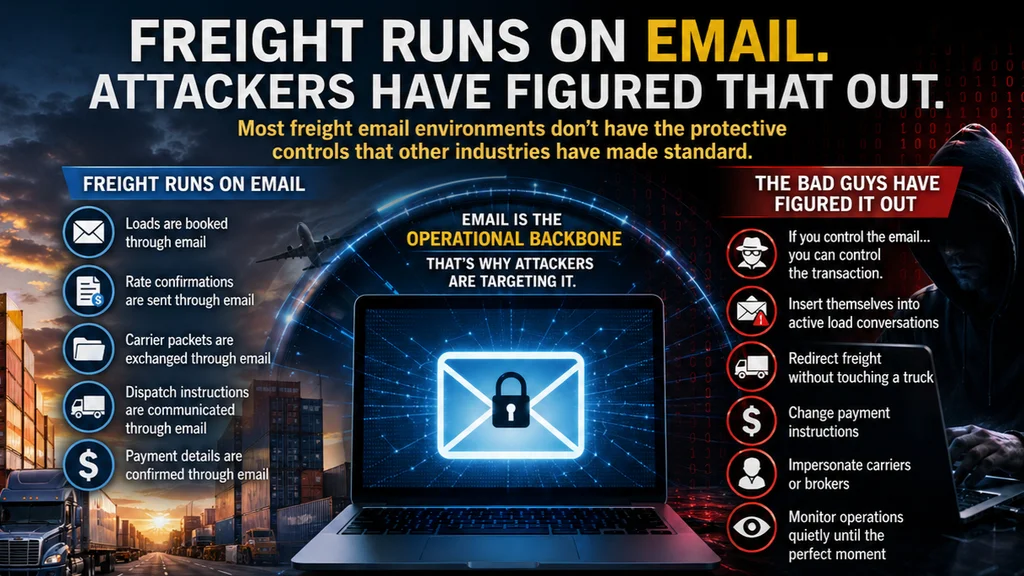
- Loads are booked through email
- Rate confirmations are sent through email
- Carrier packets are exchanged through email
- Dispatch instructions are communicated through email
- Payment details are confirmed through email
Email is not just a communication tool in transportation.
It is the operational backbone.
And that’s exactly why attackers are targeting it.
What the Bad Guys Have Already Figured Out
While many companies are still thinking about cybersecurity in terms of firewalls and antivirus, attackers have moved on.
They’ve figured out something simple:
If you control the email… you can control the transaction.
They don’t need to hack your entire network.
They don’t need to break into your servers.
They just need access to one inbox—or the ability to convincingly impersonate one.
From there, they can:
- Insert themselves into active load conversations
- Redirect freight without touching a truck
- Change payment instructions
- Impersonate carriers or brokers
- Monitor operations quietly until the perfect moment
This is why so many freight fraud incidents today look “normal” until it’s too late.
The Industry Gap No One Talks About
Here’s the uncomfortable truth:
Most freight email environments are under-protected.
Not because companies don’t care.
But because email has been treated like a utility—not a risk.
In industries like finance and healthcare, email security has evolved significantly. It’s standard to see:
- Advanced phishing detection
- Strict identity verification controls
- Domain authentication enforcement
- Behavioral monitoring on logins
- Conditional access policies
In transportation?
Many companies are still operating with:
- Basic spam filters
- Password-only logins
- Little to no domain protection
- Minimal monitoring of suspicious activity
That gap is where attackers live.
How These Attacks Actually Play Out
Most freight fraud doesn’t start with something obvious.
It usually looks like this:
- A phishing email captures login credentials
- An attacker gains access to a real inbox
- They observe communication patterns quietly
- They wait for a high-value transaction
- They insert themselves at the right moment
And from there:
- Freight gets diverted
- Payments get rerouted
- Trust gets broken
All without triggering traditional alarms.
This Isn’t IT—This Is Revenue Protection
When email is compromised in transportation, the impact is immediate and financial.
You don’t just lose data.
You lose:
- Loads
- Money
- Customers
- Reputation
That’s why this conversation needs to shift.
This isn’t about “IT security.”
This is about protecting how your business makes money.
What Should Be Standard (But Often Isn’t)
If freight runs on email, then email needs to be treated like critical infrastructure.
At a minimum, every transportation company should have:
Multi-Factor Authentication (MFA) So stolen passwords don’t become open doors
Email Authentication (SPF, DKIM, DMARC) To stop domain spoofing and impersonation
Advanced Email Security Filtering To block phishing and malicious links
Identity & Access Monitoring To detect unusual logins and behavior
Employee Awareness Training Because attackers are targeting people, not just systems
Final Thought
The freight industry has always been built on trust.
But in today’s environment, trust alone is not a security strategy.
Because the reality is:
Attackers are not trying to break your systems anymore. They are trying to become you.
And they are doing it through the one system your entire operation depends on.
Email.
Question for You: If someone gained access to your company’s email today… How much of your operation could they control?
If you’re not sure, it might be time to take a closer look.
Take the free Freight cyber risk check assessment by clinking this link
Contact us here at Ergon Consulting Group at 469-275-0446 or visit us at www.ergongrp.com
The Cyber Freight Room. Where freight meets cybersecurity