Most federal alerts are written for investigators. Here's what they actually mean if you run freight.
The FBI dropped a public service announcement on April 30 that should be sitting on every broker, carrier, and 3PL dispatch floor right now. Most operators I've talked to haven't read it. The ones who did, told me they couldn't tell what they were supposed to do about it.
That's the gap I want to close. Let me translate this is real talk.
1. The Alert That Matters
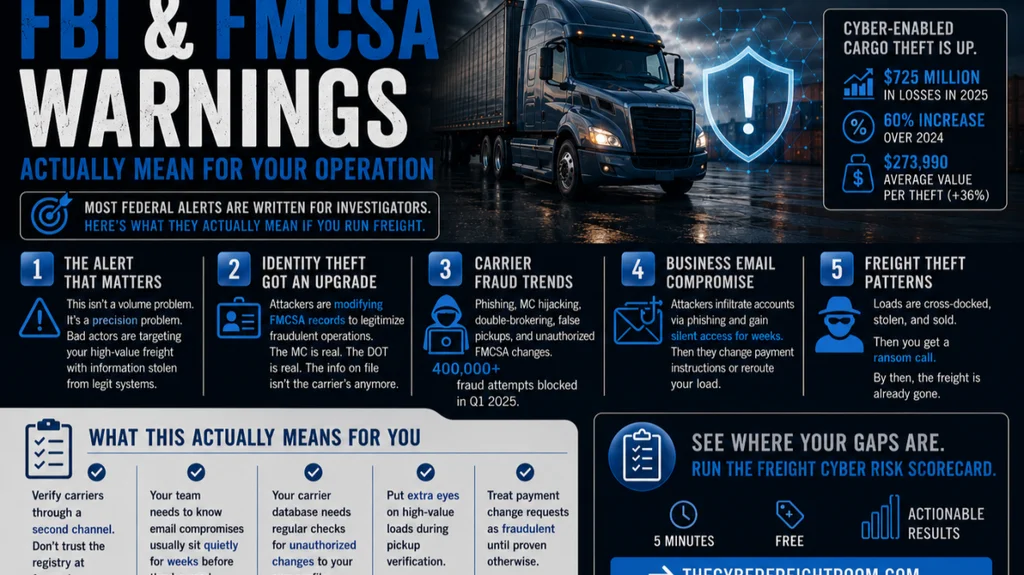
The FBI issued the PSA on April 30, 2026, warning the transportation industry about a sharp rise in cyber-enabled cargo theft. Estimated losses in the U.S. and Canada hit nearly $725 million in 2025 — a 60% increase over the year before. Confirmed cargo theft incidents rose 18%, and the average value per theft grew 36% to $273,990, reflecting more selective targeting of high-value loads.
Translation for your operation: this isn't a volume problem. It's a precision problem. The bad actors are picking your high-value freight on purpose, and they're doing it with information they pulled out of legitimate systems before the load ever moved.
2. Identity Theft Got an Upgrade
This is the part of the alert most freight operators missed. Attackers are now modifying FMCSA registration records — changing contact information, insurance records, and operating authority — to legitimize fraudulent operations under stolen identities.
Translation: the carrier you're vetting today might pass every check because the bad actor updated the federal database to make it pass. The MC number is real. The DOT number is real. The contact info on file isn't the carrier's anymore.
If you haven't checked your own FMCSA profile for unauthorized changes in the last 30 days, do it this week. Set up alerts where the registry allows it and establish a routine check of your carrier profile.
3. Carrier Fraud Trends
FMCSA issued its own warning earlier this year about a phishing scheme specifically targeting carriers — fake emails asking for credentials, login info, and registration details, all designed to take over MC numbers.
The current playbook running through the industry includes MC number hijacking, double-brokering, false pickups, and unauthorized changes to FMCSA contact information. In Q1 2025 alone, one fraud-prevention platform blocked over 400,000 fraud attempts — including 352,134 fraudulent inbound emails, 30,921 spoofed phone numbers, and 561 user access attempts from 42 countries outside North America.
Translation: if your carrier vetting still stops at "the paperwork looks right," you're operating in 2019. The paperwork is the attack vector now.
4. Business Email Compromise
The FBI describes a multi-stage attack chain that has been active since at least 2024. Attackers first compromise freight broker or carrier accounts through phishing sites that install remote monitoring software, gaining persistent, undetected access.
Translation: somebody clicks a link. The link looks legitimate. It installs software that lets the attacker watch every email and document moving through that account — quietly, for weeks. Then when the right load shows up, they insert themselves into the thread with updated payment instructions or rerouted pickup details.
The compromise happened a month before the loss. Nobody knew.
5. Freight Theft Patterns
Loads are getting cross-docked or transloaded to complicit drivers, who redirect the cargo from its intended destination and steal it for resale. In some cases, the criminal actors posing as a carrier reconnect with the broker afterward to demand a ransom for the location of the load.
Translation: the truck shows up. The pickup goes smoothly. The load disappears. Then you get a ransom call. By the time anyone realizes what happened, the freight is already broken down and gone.
What This Actually Means For You
Strip out the federal language and the operational read is short:
- Your vetting process needs a second verification channel that doesn't trust the FMCSA record at face value
- Your team needs to know that email compromises usually sit quietly for weeks before they're used
- Your carrier database needs regular checks for unauthorized changes to your own profile
- Your high-value loads need extra eyes on pickup verification, not less
- Your payment change procedures need to assume the request is fraudulent until proven otherwise
The federal alerts are telling us what the bad actors are doing. The question is what your operation is doing differently this month than it did last month.
Start With Where You Stand
The FBI alert is the loud signal. Your weekly operations are the quiet one. The gap between what these warnings describe and what your team is actually set up to catch is where the next loss is going to come from.
Run the Freight Cyber Risk Scorecard to find out where that gap lives in your operation. Takes 5 minutes, it's free, and the result will tell you which of these federal warnings your shop is positioned to handle and which ones would walk right through the door.
Federal alerts don't move freight. You do. Better to know where the gaps are before the alert becomes your loss.
The Cyber Freight Room — Where freight meets cybersecurity. 🚛🔐