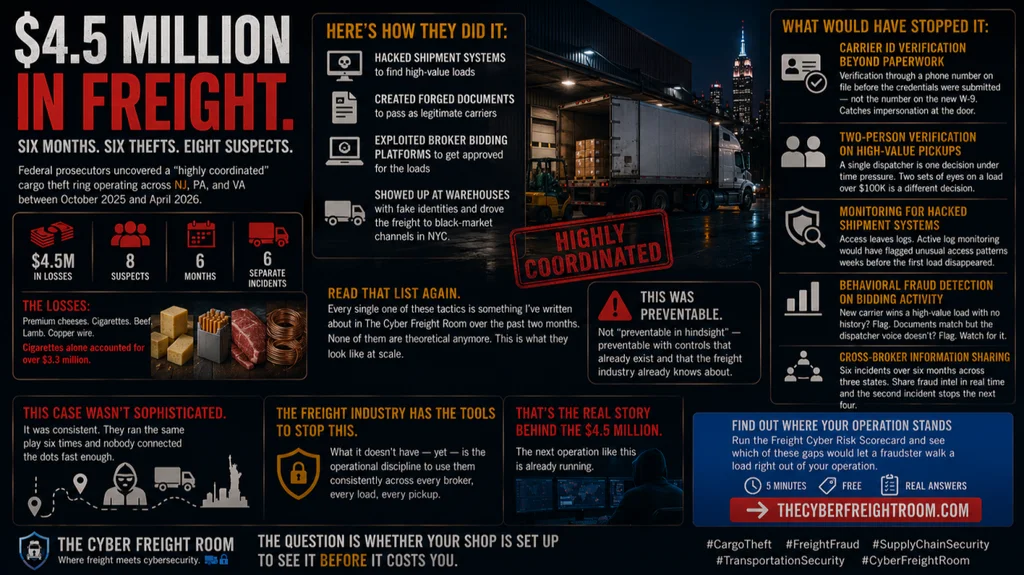
Some weeks ago, federal prosecutors uncovered what they called a "highly coordinated" cargo theft ring operating across New Jersey, Pennsylvania, and Virginia between October 2025 and April 2026. Premium cheeses. Cigarettes. Beef. Lamb. Copper wire. Cigarettes alone accounted for over $3.3 million of the losses.
Here's how they did it:
→ Hacked shipment systems to find high-value loads
→ Created forged documents to pass as legitimate carriers
→ Exploited broker bidding platforms to get approved for the loads
→ Showed up at warehouses with fake identities and drove the freight to black-market channels in New York City
Read that list again. Every single one of those tactics is something I've written about in The Cyber Freight Room over the past two months. None of them are theoretical anymore. This is what they look like at scale.
Here's the part that matters: this was preventable.
Not "preventable in hindsight" preventable with controls that already exist and that the freight industry already knows about.
What would have stopped it:
Carrier identity verification beyond paperwork. The fraudsters passed carrier vetting because the documents looked right. Verification through a phone number listed on FMCSA file before the credentials were submitted not the number on the file may have caught the impersonation at the door.
Two-person verification on high-value pickups. A single dispatcher confirming a pickup is one decision under time pressure. Two sets of eyes on a load over $100K is a different decision. The fraudsters were counting on the first scenario.
Monitoring for hacked shipment systems. They got into broker bidding platforms. That access leaves logs. Active log monitoring would have flagged unusual access patterns weeks before the first load disappeared.
Behavioral fraud detection on bidding activity. New carrier wins a high-value load with no prior history on the platform? That's a flag. Carrier shows up with documents that match exactly but a dispatcher voice that doesn't? That's a flag. Most operations aren't watching for either.
Cross-broker information sharing. Six separate incidents over six months across three states. If brokers were sharing fraud intelligence in real time, the second incident would have stopped the next four.
This case wasn't sophisticated. It was consistent. They ran the same play six times and nobody connected the dots fast enough.
The freight industry has the tools to stop this. What it doesn't have yet is the operational discipline to use them consistently across every broker, every load, every pickup.
That's the real story behind the $4.5 million.
If you want a real read on where your operation stands against this exact playbook, run the Freight Cyber Risk Scorecard at thecyberfreightroom.com. Five minutes. Free. Tells you which of these gaps would let a fraudster walk a load right out of your operation.
The next operation like this is already running.
The question is whether your shop is set up to see it before it costs you.
#CargoTheft #FreightFraud #SupplyChainSecurity #TransportationSecurity #CyberFreightRoom