If your broker, carrier, or 3PL operation is paying for cybersecurity tools right now, this one's going to land hard.
The product you bought last year was designed for the threat landscape of two years ago. The roadmap your vendor showed you was built before AI changed what was possible on both sides of this fight. And the contract you signed for the next 24 months is locking your operation into a defense posture that's already outdated.
That's not the vendor's fault. The ground moved faster than anyone planned for. But it's your operation that pays the price if you don't adjust.
What Changed
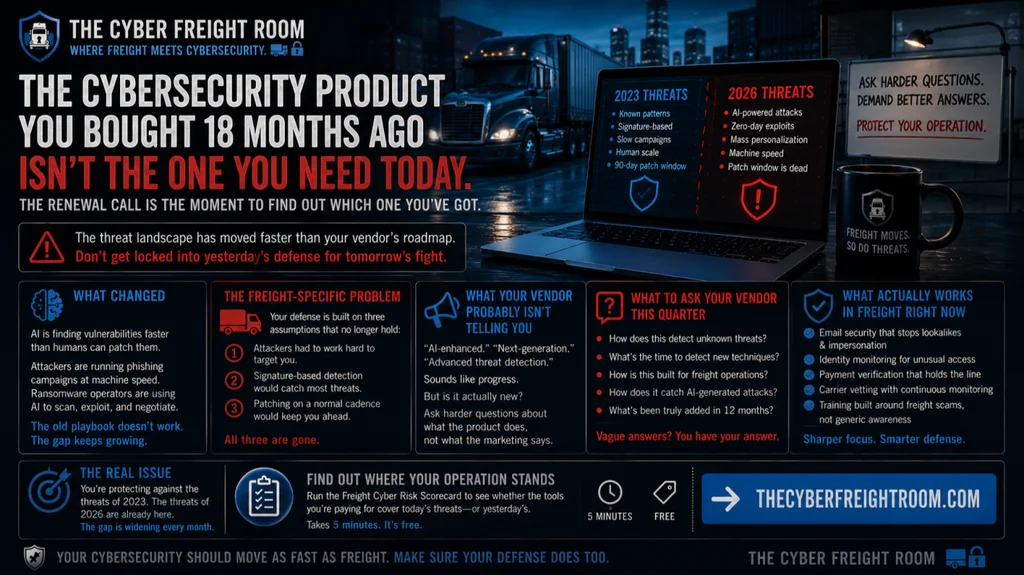
In the last 18 months, the cybersecurity industry went through a shift most freight operators haven't seen coverage of. AI is now finding vulnerabilities faster than humans can patch them. Attackers are running phishing campaigns at machine speed, generating thousands of personalized frauds attempts a day. Ransomware operators are using AI to scan target networks, write custom malware, and negotiate with victims.
Your cybersecurity vendor's product was built before any of that was practical at scale. The detection rules were written for the old playbook. The threat intelligence feeds were tuned for the old attack patterns. The "next-generation" features in your subscription renewal? Most of them are answering questions the bad actors stopped asking eighteen months ago.
The Freight-Specific Problem
Most freight companies didn't build their cybersecurity strategy from scratch. They bought what their TMS vendor recommended, or what their MSP packaged, or what their insurance carrier required for a discount. Practical, reasonable decisions at the time.
Here's the issue. Those decisions added up to a defense built around three assumptions that don't hold anymore:
The first assumption was that attackers had to work hard to target you specifically. That's gone. AI lets attackers run customized campaigns against thousands of brokers simultaneously. You're not too small to be a target. You're cheap to target.
The second assumption was that signature-based detection — the kind of "we've seen this attack before, here's what to look for" approach — would catch most threats. That's gone too. AI-generated phishing emails, deepfake voice calls, and dynamically generated malware don't match any signature.
The third assumption was that patching on a normal cadence would keep you ahead of vulnerability exploitation. That window closed in the last year. Vulnerabilities are getting weaponized faster than most operations can deploy fixes.
What Your Vendor Probably Isn't Telling You
The vendors who sold you the current generation of tools have a problem. They can't admit their product roadmap is behind the threat landscape without losing customers. So, the language gets softer. "AI-enhanced." "Next-generation." "Advanced threat detection." Words that sound like progress but don't change what the product actually does under the hood.
Some vendors are doing real work to catch up. Some are slapping AI labels on the same product they had in 2023. From the outside, those two things look the same.
The way to tell the difference is to ask harder questions about what the product is actually doing, not what the marketing says it does.
What to Ask Your Vendor This Quarter
A few questions worth raising on your next renewal call:
- How does this product detect threats that don't match any known signature or pattern?
- What's the average time between when a new attack technique appears in the wild and when this product can detect it?
- How is this product specifically designed for freight operations — TMS access, load board activity, carrier and customer communication patterns?
- If an attacker uses AI to generate a phishing email that looks legitimate, what in this product would catch it?
- What's been added to the product in the last 12 months that's actually new versus rebranded?
If the answers are vague, you have your answer about whether the roadmap is keeping up.
What Actually Works in Freight Right Now
The freight operations getting this right aren't necessarily buying more tools. They're tightening what they already have around behaviors specific to how fraud actually shows up in this industry:
- Email security that catches the lookalike domains and impersonated dispatchers, not just generic spam
- Identity monitoring that flags unusual access to the TMS or accounting platform
- Payment verification procedures that don't bend for urgent requests
- Carrier vetting integrated with continuous monitoring, not just initial setup
- Employee training built around the specific scams hitting freight operations, not generic cybersecurity awareness
The shift isn't to a new product. It's to a sharper question about whether your current stack is actually built for the threats you're facing.
The Real Issue
Most freight operations are protecting themselves from the cybersecurity threats of 2023. The threats of 2026 are already in their inbox, in their phone calls, and in their TMS logins. The gap between what you're paying for and what you actually need is widening every month.
Find Out Where Your Operation Stands
Run the Freight Cyber Risk Scorecard to see whether the tools you're already paying for cover the threats actually showing up in freight operations right now — or whether you've been protecting against the last war. Takes 5 minutes. It's free.
The cybersecurity product you bought 18 months ago isn't the one you need today. The renewal call is the moment to find out which one you've got.
The Cyber Freight Room — Where freight meets cybersecurity. 🚛🔐